Full Stack & Mobile Developer · Solo Build
Chowzee
A complete food-delivery platform, customer app, rider app, restaurant and admin dashboard, and the API behind them, designed and built solo as four connected products
4
Connected products
79
REST endpoints
14
Database migrations
4
Roles: customer, rider, owner, admin
56
App and dashboard screens
26k
Lines of TypeScript & Python
Overview
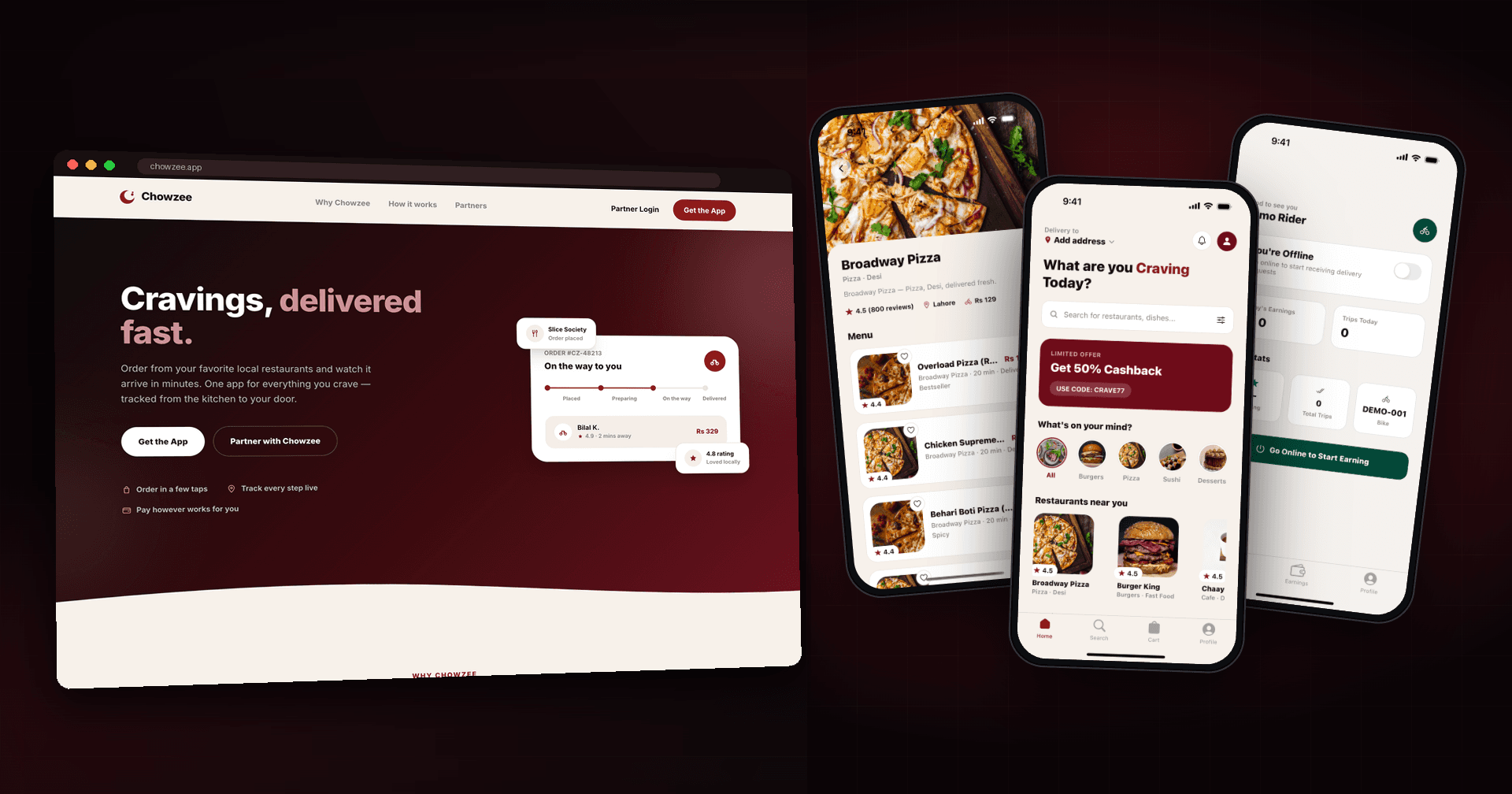
Chowzee is a food-delivery platform for the Pakistani market, built as the full set of products a delivery business actually needs rather than a single app. Customers browse restaurants and dishes, customise orders with add-ons, check out, track their order live, earn loyalty points and referral bonuses, and chat with their rider. Riders apply with vehicle and CNIC details, get approved by an admin, go online, and work through assigned deliveries. Restaurant owners run their kitchen from a web dashboard, menu, availability, incoming orders and earnings, and an admin console oversees riders, restaurants, orders and promo codes platform-wide. Everything talks to one FastAPI backend on Postgres with Supabase Auth, and I built every layer myself: the two mobile apps, the web dashboards, the API, the schema and the deployment.
The Challenge
A delivery platform is really four products sharing one set of rules. The same order has to look different to a customer, a kitchen, a rider and an admin, and each of them must only ever see and change their own slice of it. Riders and restaurants cannot self-approve, orders move through a strict lifecycle, and a failed handoff has to be reassigned without rewriting order history. On top of the data model, real-device testing surfaced a nasty networking problem: on some devices the connections to Supabase and to the image CDN hung retrying HTTP/3 (QUIC) and never fell back, so login, background token refresh and food photos all stalled even though the server's own requests to the same hosts were fine.
How We Solved It
One API, four roles, enforced server-side
A single FastAPI service backs every client. Supabase-issued JWTs are verified locally against the project's public JWKS, no network call per request, and role-based dependencies guard each router. Cross-tenant access returns 403, missing tokens 401, and invalid state transitions 409. Profiles are auto-provisioned on first sight of a new Supabase user, then promoted by their own application and approval flows rather than by the client.
Order lifecycle separate from delivery lifecycle
Orders move placed → accepted → preparing → ready for pickup → completed (or rejected / cancelled), owned by the restaurant side. Deliveries are a separate table with their own stages, assigned → to pickup → to drop-off → delivered, owned by the rider side, so a failed handoff can be reassigned to a new rider without touching order history. Subtotals, add-on pricing, delivery fees, promo-code discounts and loyalty-point redemption are all calculated on the server from catalogue prices, never trusted from the client.
Approval-gated marketplace
Restaurants and riders both start as pending. Restaurants stay hidden from the public catalogue until an admin approves them, and riders cannot go online until approved. The admin console lists applications, approves or suspends partners, and shows a platform-wide order feed across every restaurant.
Customer app built for ordering speed
An Expo Router app with 31 screens: category and restaurant browsing, dish pages with add-ons and special instructions, cart, checkout with saved addresses and payment methods, scheduled orders, live order tracking, in-order chat with the rider, favourites, reviews, notifications and a vendor mode. Loyalty points accrue per spend and referral codes pay out both sides once the referred user's first order is delivered, guarded so the bonus can fire only once.
Rider app with live location
A separate Expo app for riders: application with vehicle, CNIC and licence details, a pending-approval gate, an online/offline switch, incoming delivery requests, an active-delivery screen that walks pickup and drop-off, earnings by day and week, and periodic location snapshots while online. The API deliberately treats location as a coarse, low-frequency snapshot rather than a live feed, so location writes never contend with order data.
Restaurant and admin web dashboards
A Next.js 16 app with a marketing landing page plus two protected consoles. Restaurant owners manage their menu with availability toggles, accept and progress incoming orders, flip the restaurant open or closed, and review earnings. Admins manage riders, restaurants, orders and promo codes. Both share one design system and the same Supabase session.
Fixing the QUIC problem with transparent relays
After confirming the stall from real device logs, I added narrowly scoped relays on the backend: an auth relay that forwards Supabase Auth calls as a dumb pipe (no extra privilege, the client's own headers pass through), a storage relay for avatars, and an image relay locked to an allow-list of photo hosts so it can never become an open SSRF proxy. The mobile apps' Supabase client uses a custom fetch that reroutes through them, which also makes automatic token refresh reliable.
Schema, migrations and scheduled jobs
SQLAlchemy 2.0 models with 14 Alembic migrations, a seed script for real restaurant chains with menus and photos, and a scheduled-orders release endpoint protected by a shared cron secret and triggered every five minutes by a GitHub Actions workflow, no queue or worker infrastructure needed at this scale.
Customer App
Rider App
Website, Restaurant & Admin Dashboards
Results & Impact
Four products, one codebase family
Customer app, rider app, restaurant and admin web, and API, all designed, built and wired together end to end by one developer.
79 endpoints, 14 migrations
A fully typed REST API with generated OpenAPI docs and a versioned schema, exercised end to end against a live database including the 401 / 403 / 409 failure paths.
56 screens across three clients
31 customer-app screens, 10 rider-app screens and 15 web pages, sharing one brand and one auth model.
Marketplace rules enforced in the API
Approval gates, tenant isolation, server-side pricing and a strict order state machine, not left to the clients to get right.
A real-world networking bug diagnosed and fixed
Traced a QUIC / HTTP3 stall to real device logs and shipped a safe relay layer that made login, refresh and image loading reliable.
Built July to August 2026
Roughly two weeks of commit history across the four repositories, shipped with a seeded catalogue of 16 restaurants and ~100 dishes.
Technical Architecture
Have a similar project?
I'm open to freelance projects and full-time roles. Let's build something great together.